


High-Performance Industrial PCB Design Guide
 25 Feb 2026 16:12:05 GMT
By admin
25 Feb 2026 16:12:05 GMT
By admin
Introduction
Industrial electronics operate in harsh environments: extreme temperatures, heavy vibrations, electrical noise, and continuous 24/7 operation. Unlike consumer-grade PCBs, industrial high-performance PCBs must maintain signal integrity in noisy factories, survive thermal cycles in outdoor equipment, and run reliably for 10+ years to avoid costly downtime or safety hazards. These PCBs are the nerve centers of machinery, industrial control systems, power converters, and sensors, so "high-performance" here means robust, durable, and designed with wide safety margins to handle the unknowns of industrial settings.
________________________________________
Selecting Materials for Reliability
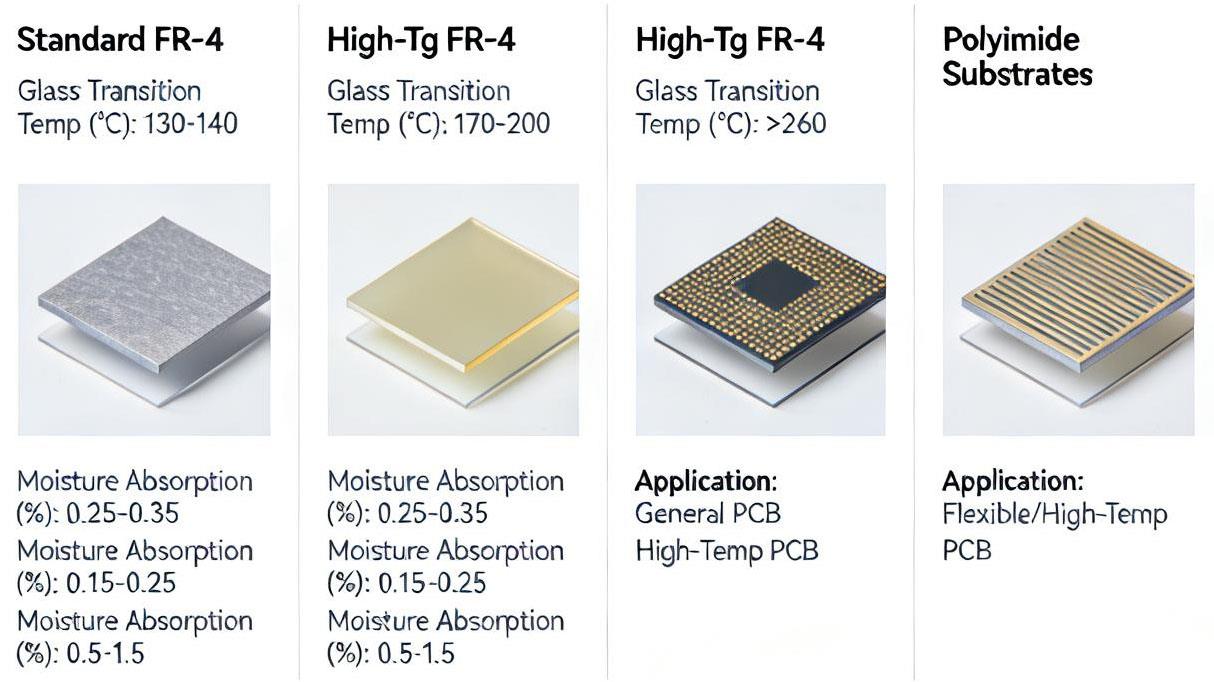
Standard FR-4 (Tg ~130°C) is insufficient for high-temperature industrial environments. For motor drives or equipment near engines that reach 120°C continuously, high-Tg FR-4 (Tg ≥170°C) or polyimide substrates are recommended to prevent warping or delamination; polyimide can withstand 200°C+ but has higher costs. Low coefficient of thermal expansion (CTE) materials are critical to avoid cracks in vias and solder joints under thermal cycling, with filled vias and high-Tg glass mitigating CTE mismatch. For high-power or high-frequency applications like radar or RF power amplifiers, specialized laminates like Rogers or Teflon-based substrates offer stable dielectric properties and heat resistance, though they are more expensive. Always choose substrates that exceed the worst-case temperature the PCB will encounter, with a 20-30% safety margin to ensure longevity.
________________________________________
PCB Stack-Up for Power and Signal Integrity
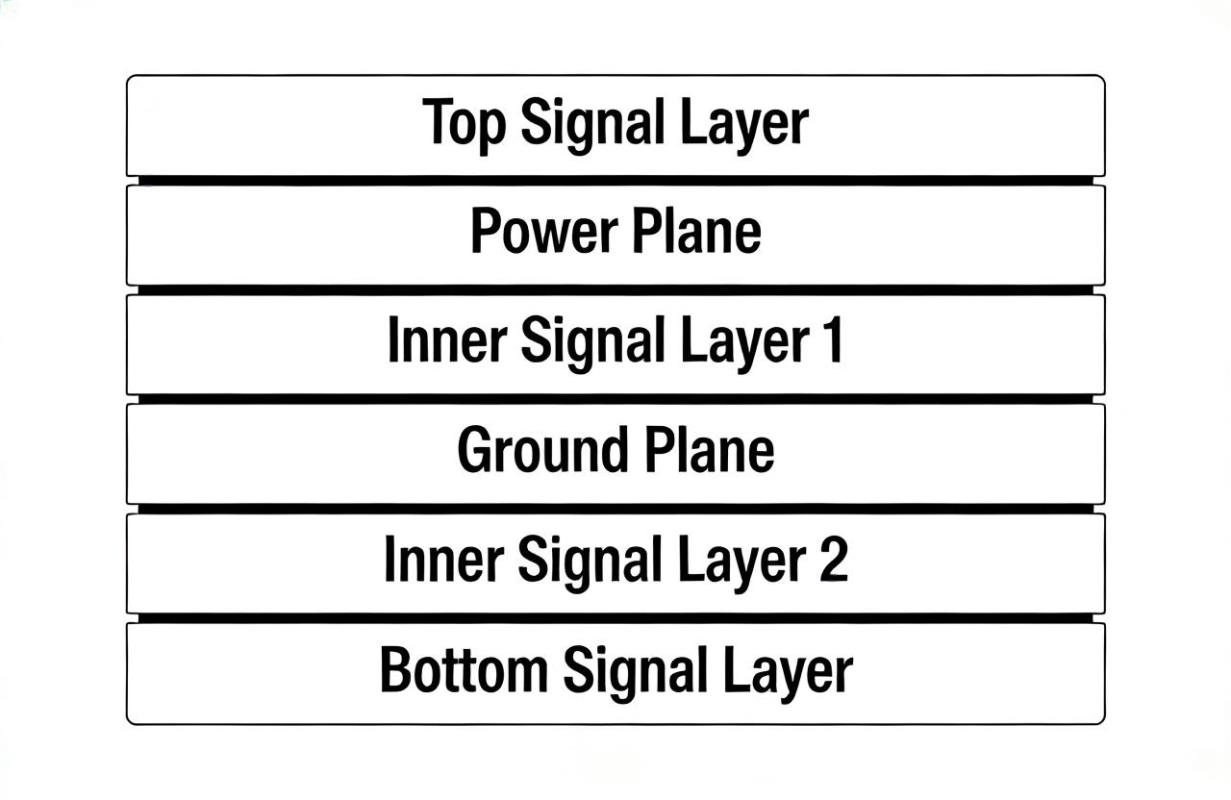
Multi-layer stacks (4-6 layers) are standard for industrial PCBs to support complex circuits, controlled impedance, and stable power delivery. A 6-layer stack-up typically uses the configuration: Top Signal Layer, Power Plane, Inner Signal Layer 1, Ground Plane, Inner Signal Layer 2, Bottom Signal Layer. This setup ensures each signal layer is adjacent to a ground or power plane, minimizing signal loss and EMI by providing a continuous return path for signals. Dedicated ground and power planes reduce voltage drop for power traces and act as heat spreaders, dissipating heat from components across the board. For high-current nets like a 5V 10A supply line, use entire copper layers to provide a low-resistance path, and the plane-to-plane pairing adds capacitance to decouple and stabilize power (the "power plane capacitor" effect). Symmetric stack-ups balance copper distribution to prevent warping under thermal stress, ensuring planarity for reliable soldering and mechanical fit, which is critical for maintaining component alignment over the PCB's lifespan.
________________________________________
Thermal Management Techniques
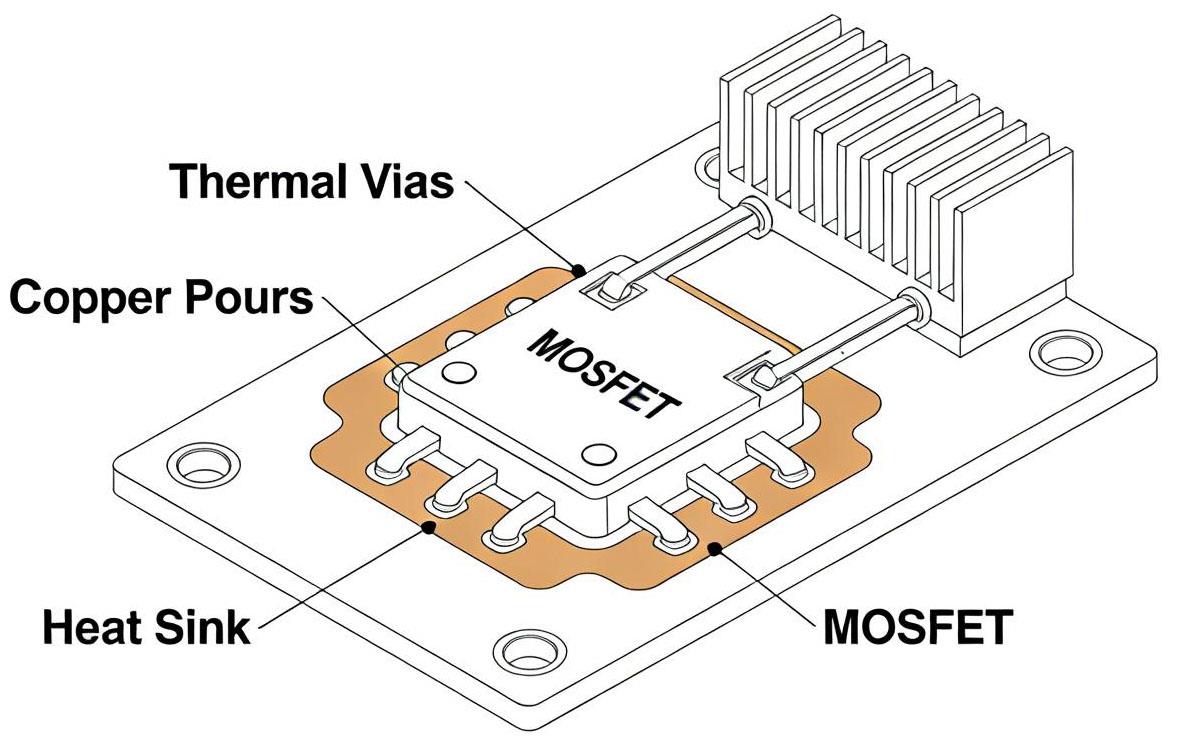
Industrial PCBs handle significant power, so effective thermal management is critical to prevent component overheating and premature failure. Thermal via arrays under hot components (voltage regulators, MOSFETs) conduct heat to inner copper layers or the opposite board side; for a 10A D2PAK MOSFET, an array of 12 0.3mm thermal vias under its thermal pad can reduce the component's junction temperature by 25°C, extending its lifespan by 30%. Large copper pours and 2oz+ thick planes spread heat laterally, acting as built-in heatsinks that can dissipate 5W of power per square inch without additional cooling. For high-power designs over 20W, attach external heat sinks or use metal-core PCBs, which have 8 times higher thermal conductivity than standard FR-4. Place heat-generating components in areas with airflow, away from temperature-sensitive parts like precision analog amplifiers, and use thermal relief patterns for through-hole leads on large planes to avoid cold solder joints during manufacturing.
________________________________________
Vibration and Shock: Designing for Durability
Industrial PCBs face constant vibration (5-10G in factory conveyor systems) and occasional shocks, which can crack solder joints or damage components over time. Secure PCBs with 4+ mounting standoffs to reduce flex, adding support points near heavy components like transformers. Avoid tall or heavy components; replace large can electrolytic capacitors with lower-profile types or support them with plastic clamps, and place large-mass components near mounting points to minimize board strain. Reinforce solder joints with silicone adhesives or epoxy potting (staking) for sensitive parts like microcontrollers, which reduces component displacement by 80% under shock. Use 2.0mm thick PCBs instead of standard 1.6mm boards to increase rigidity, as thicker boards have 60% higher bending stiffness, and test prototypes to MIL-STD-810 standards to validate durability under real-world vibration.
________________________________________
Protecting Against Moisture, Dust, and Corrosion
Industrial environments expose PCBs to moisture, dust, and chemicals, which can cause corrosion or short circuits. Conformal coatings (acrylic, silicone, urethane) seal PCBs to prevent corrosion; silicone coatings reduce corrosion risk by 90% in 80% RH humid environments, and urethane coatings resist industrial solvent splashes. Collaborate with mechanical engineers to achieve IP65/IP67 ratings using gaskets and sealed enclosures, and use ENIG (gold plating) for PCB pads in corrosive atmospheres, as ENIG has 3 times higher corrosion resistance than HASL finishes. Follow IPC-2221 standards for creepage and clearance, increasing minimum clearance by 20% for high-voltage circuits (over 24V) to avoid arcing in dusty settings.
________________________________________
EMI/EMC Immunity
Industrial settings have high electromagnetic interference from motors, solenoids, and switching circuits, which can cause signal distortion or data loss. Use a contiguous ground plane for solid grounding, or partitioned grounds tied at a single point for analog/digital separation to avoid noise coupling. For industrial communication buses like RS-485, differential routing with a ground plane reference reduces EMI susceptibility by 60% compared to single-ended routing. Use input filters (ferrite beads, common-mode chokes) and decoupling capacitors (10µF electrolytic + 0.1µF ceramic) to block noise from power lines, reducing conducted EMI by 45%. Add metal shields for sensitive analog sections, which reduce radiated EMI interference by 70%, and incorporate TVS diodes to handle 20kV transient voltages from lightning or inductive load kickback.
________________________________________
Conclusion
Designing high-performance industrial PCBs requires a holistic focus on robustness and reliability. By selecting appropriate materials, planning stack-ups for power and signal integrity, managing heat, resisting mechanical stress, protecting against environmental hazards, and ensuring EMI immunity, engineers can create PCBs that operate reliably in harsh industrial environments. Conservative design rules, like larger safety margins on clearances and heavier copper weights, justify the cost by avoiding expensive system failures, making these PCBs the unsung heroes of industrial machinery and critical infrastructure.
-
02 Mar 2026 17:51:40 GMT
PCBA Functional Testing: Methods and Industry Standards
-
27 Feb 2026 12:48:42 GMT
The Complete PCBA Quality Control Checklist for Exporters